

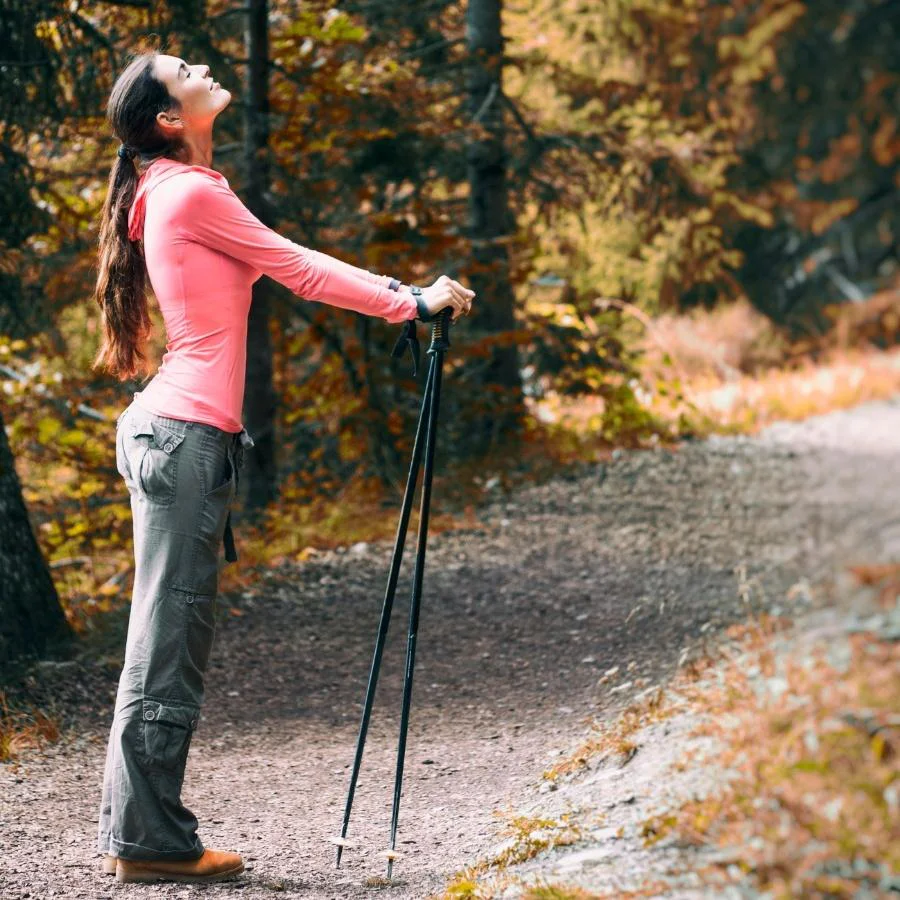
Probably, each of us has seen people walking with special poles. This is Scandinavian walking, one of the simplest, most accessible and enjoyable types of physical activity. However, unlike ordinary walking, it involves a number of special steps and techniques, thanks to which there is a load on different parts of the body.
Walking with canes involves almost all the muscles of the upper body that are hardly used during the day (at least when walking normally). In particular, the muscles of the shoulder girdle, back, abs, chest, etc.
This type of physical education increases endurance, which is necessary for people with health problems and professional athletes. It restores mobility and a full life after musculoskeletal injuries.
Nordic walking is a great idea when relaxing in the Carpathians, because the mountainous terrain has its own characteristics. If in a regular flat area you can burn up to 400 kcal/hour, then Nordic walking in the Carpathians allows you to spend up to 600 kcal per hour.
KYIVSKA RUSS is a modern hotel in Skhidnytsia. Tourists are welcome here at any time of the year. You can rent Nordic walking poles in the establishment and experience its benefits. And if you add clean mountain air and magnificent views, the effect will be simply amazing!
What is Nordic walking?
Nordic walking (often called Finnish walking) has an interesting history. Over 90 years ago, Finnish skiers were looking for a way to stay in shape during the snowless season. Then they started switching their skis to sneakers, but left the poles behind to put more weight on their arms.
Yes, Nordic walking has a number of health benefits. It is recommended for those who want to maintain good physical shape, improve metabolism, lose weight, adhere to a healthy lifestyle. Just an hour of Nordic walking, and you can burn up to 700 calories per hour. And not only that. It strengthens the body, increases endurance, has a positive effect on the work of the heart and lungs. It is recommended for depression, nervous system disorders, and vegetative-vascular dystonia.
The main attribute for Nordic walking is trekking poles. Outwardly, they resemble ski poles, but differ in height and length. This allows you to move the load.
Overall, this is a great method of healing and strengthening the body, and at the same time, an excellent way of rehabilitation.
What does Nordic walking treat?
Nordic walking is beneficial for everyone, young and old. It can be done to maintain muscle tone, after injuries, during rehabilitation, as it places little strain on the joints. It has the following health benefits:
- Nordic walking involves a large number of muscles. In addition to the lower body, athletes also work the upper body (shoulders, back, arms).
- While walking, the muscles of the shoulder and back are strengthened. After a while, you will forget about back pain and discomfort. And your posture will become better.
- Improving metabolism. Regular exercise helps improve metabolic processes. This contributes to weight loss.
- Positive effect on the cardiovascular system. This sport is an excellent prevention of cardiovascular diseases. The heart becomes more resilient, and the blood vessels become stronger.
- Rejuvenating effect. Walking in the fresh air has a positive effect on the appearance, the cells are saturated with oxygen. The skin of the face looks better.
- Good mood. Walking outdoors increases the level of endorphins in the body, which has a positive effect on mood and overall well-being.
Nordic walking technique
At first glance, this type of physical activity is very simple. But even here there is a technique for its implementation. And in order for the classes to bring both benefit and pleasure, it is worth knowing the rules of Nordic walking and following them.
The workout begins with a warm-up: 5-15 minutes of simple exercises are enough to warm up the body. After the warm-up, you can start walking.
Don't forget a few key points:
- Follow your natural rhythm when walking.
- You don't just need to rearrange the sticks, you need to lean on them.
- In the upper position, the arm should be bent at an angle of no more than 45°.
- In the lower position, the hand moves freely back.
- The arms should work from the shoulder, not the elbow.
- The steps should be rhythmic, heel to toe.
How to choose poles for Nordic walking?
To practice Nordic walking, you need special sliding poles that can be easily adjusted to a person's height. This is a spring that absorbs the impact when it hits the ground. At the same time, it makes it impossible to put a large impact load on your hands. Thanks to the poles, you can easily cover even a long distance.
Strength, lightness and readiness to withstand any loads are the main requirements that Nordic walking poles must meet. When choosing poles, it is worth paying attention to:
- The material the poles are made of. Many brands use aluminum, which is lightweight and durable and has a long shelf life. You can also buy carbon poles, which are also lightweight and durable.
- Weight. Light poles allow you to maintain speed and balance. This is important for long-distance training. The average weight of poles is from 300 to 400 g.
- Length. It should correspond to a person's height. So, if the height is up to 165 cm, then you should choose a stick with a length of 105 cm. For height from 166 to 170 cm - 110 cm. And if the height is over 190 cm - 135 cm.
When choosing poles, it is worth considering their ergonomics and the presence of a lanyard loop. This allows you to quickly grab the poles and lean on them when walking back.
It is also important to pay attention to the comfort of the handles and loops on the stick. The handles help prevent your hand from slipping and also reduce the strain on your wrists and elbows.
To ensure that your workouts bring only positive emotions, you should choose the right clothes and shoes. The clothes should be of high quality, comfortable, and appropriate for the season. And the shoes should have flexible soles and provide reliable grip on the track.
What are the benefits of Nordic walking?
People often ask what the benefits of Nordic walking are. It is in particular demand because it has a number of advantages:
- This is the best sport for people who have a sedentary job and a sedentary lifestyle. Regular walks with poles will perfectly tone the muscles and prepare the body for more intense loads.
- Nordic walking helps strengthen the muscles of the abs, back, arms, and buttocks. Regular practice improves posture and coordination of movements.
- Unlike running, Nordic walking with poles does not exert impact pressure. Therefore, it is recommended for people who are overweight or suffer from joint diseases.
- Walking in the fresh air improves sleep, helps get rid of depression, and has a positive effect on the state of the nervous system.
- This activity is useful for people suffering from bronchial asthma, as walking helps increase lung capacity by 30%.
- ·When following the Nordic walking technique, more than 90% muscles are used. And during regular walking, no more than 70% muscles are used.
- Regular Nordic walking helps strengthen the heart vessels, lowers blood cholesterol levels, normalizes blood pressure, metabolism and bowel function, and helps the body get rid of toxic substances faster. This is a great way to prevent hypertension and coronary heart disease. In addition, it is a proven way to combat excess weight.
In general, Nordic walking has practically no contraindications. And you can walk with poles even when any other physical activity is prohibited.
The main directions of Nordic walking
Specialists distinguish three main areas of Nordic walking: amateur, sports, and therapeutic.
Amateurs master the technique because it is more useful and safer than just long walks. But some people don't worry at all about counting steps or kilometers.
Sports are chosen by people who have a specific goal. Often this is the desire to have a toned figure, increase the body's endurance. Here it is important to monitor the level of load and strictly adhere to the training schedule, counting kilometers.
Nordic walking can have a healing effect, and this is not a myth. It is often recommended for those who have had various injuries or joint damage. In addition, many athletes begin rehabilitation with Nordic walking. The level of load gradually increases, and later the athlete can return to previous activities. Also today there are diseases for which regular Nordic walking is simply a lifesaver. In particular, these are cardiovascular diseases.
Doctors recommend Nordic walking to the elderly, those with arthrosis, arthritis. And not only. This is a useful activity for people of different age categories
